
The single most predictive longevity number in cardiovascular medicine, measured on the PNOĒ platform in under 15 minutes, with an 18-page report and your biological age printed on the front page.
30-minute call. No obligation. Concierge practice. HSA and FSA eligible.
Reviewed by Dr. Meredith Sweeney, MD, FACS, FASMBS | Board-certified bariatric surgeon, A4M member, founder of Sano Longevity in Middletown. Last updated April 2026.
Test type Exercise ramp on bike or treadmill
Duration Under 15 minutes
Platform PNOĒ metabolic and cardiorespiratory analysis
Output 18-page Biological Age & Performance Analysis report
Headline result Biological age compared to chronological age, printed on the front page
Training zones returned 5 zones with exact heart rate ranges and energy split (fat% vs carb%)
Clinical reference According to the American Heart Association, VO2 max is the strongest single predictor of all-cause mortality
Patient outcome benchmark Sano patients have improved VO2 max by 33% in 6 months, corresponding to a 30 to 45% reduction in all-cause mortality risk per AHA data
Pricing $250 initial test (includes expert consultation), $175 repeat test
Included in Longevity Program and Weight Loss Program memberships
VO2 max measures the maximum amount of oxygen your body can use during intense exercise, expressed in milliliters per minute per kilogram of body weight. It is the cleanest functional measurement of how well your heart, lungs, blood, and muscles work together to keep you alive and moving.
According to the American Heart Association, VO2 max is the strongest single predictor of all-cause mortality. Higher VO2 max correlates with longer life, lower risk of cardiovascular events, lower risk of metabolic disease, and a more functional body in the years you have. Lower VO2 max correlates with the opposite.
Most longevity markers are correlated with outcomes. VO2 max is causal in the sense that improving it improves the underlying systems that determine how long and how well you live. It is also one of the few longevity numbers a patient can move dramatically in a short period of time with the right training protocol.
Traditional healthcare does not measure it. Your gym does not measure it. Sano Longevity measures it on the same PNOĒ platform used by elite endurance research labs, longevity clinics, and cardiologists across the country.
Because it’s the #1 predictor of longevity. Cardiorespiratory status directly relates to how functional we are in our later decades. Training for it now optimizes you to be the most fully functional, kick-ass 80-year-old version of yourself possible.
“In the operating room I would see the ravaging effects of metabolic dysfunction on the body. And what’s sad is that with proper education and proactive medical care we could have avoided ending up here.”
Dr. Meredith Sweeney, MD, FACS, FASMBS
By her own count, Dr. Sweeney spent 90% of her time outside the operating room managing the lifestyle and metabolic health of her bariatric patients. She was filling a gap the system was not filling. She does not run VO2 max testing on every Sano patient because it is a marketing claim. She runs it because she has spent more than a decade watching what happens when a body’s cardiovascular and metabolic systems fail, and she is not interested in waiting for that to be the next patient.
“I am a fixer, I always have been, which is why I went into surgery in the first place. At Sano Longevity I still help patients fix their health, I just do it from the ground up.”
Dr. Meredith Sweeney
VO2 max is the bottom. Fix it, and almost every other longevity marker on the panel improves alongside it.
The PNOĒ platform captures cardiorespiratory and metabolic data continuously for the duration of the exercise ramp. Here is what the rig is tracking while you ride or run
The maximum oxygen uptake your body achieves during the test, measured in ml/min/kg. This is the headline number and the input for biological age and training zone calculations.
A composite of how efficiently your cardiovascular system delivers oxygen to working muscle.
The exact heart rate at which your body switches from burning primarily fat to burning primarily carbohydrate. Critical for fat loss programming.
How many calories you burn at each training zone, broken down by fat and carbohydrate source.
How fast your heart rate and oxygen consumption return to baseline after peak effort. A clean recovery signal predicts cardiovascular resilience.
PNOĒ also captures respiratory capacity, expiratory power, breathing and cognition, and breathing and stability. These are inputs to your biological age and to the personalized training plan.
PNOĒ does not return a single number. The platform delivers an 18-page report that translates the raw data into a usable longevity and training plan. Here is what is in it.
Biological age vs chronological age, printed on the front page
VO2 max wellness prediction curve showing your trajectory
Five training zones with exact heart rate ranges and the physiological benefit of each zone
Energy consumption per zone, broken down by fat percent vs carbohydrate percent burn
Fuel source crossover point, the heart rate at which you switch from fat to carb burning
Personalized training program with resistance, interval, and cardio splits
Testing schedule for follow-up retesting
Most fitness apps prescribe heart rate zones from a generic age-based formula. Sano prescribes zones from your actual VO2 max test data. Here is the structure the PNOĒ report returns, with example heart rate ranges from a typical Sano patient.
| Zone | Heart Rate Range (example) | Primary Benefit |
|---|---|---|
| Zone 1 | 115 to 125 bpm | Active recovery, parasympathetic restoration |
| Zone 2 | 125 to 147 bpm | Fat burning, mitochondrial density, base aerobic capacity |
| Zone 3 | 147 to 177 bpm | Heart fitness, cardiac output, functional aerobic threshold |
| Zone 4 | 177 to 190 bpm | VO2 max development, anaerobic threshold |
| Zone 5 | 190 to 194 bpm | Peak performance, neuromuscular power |
These ranges are illustrative. Your actual zones are calculated from your VO2 max test result and printed on your 18-page report. Most Sano longevity protocols build the bulk of weekly training volume in Zone 2 (fat burning and mitochondrial work) with targeted Zone 4 intervals to drive VO2 max gains.
The VO2 max number tells Dr. Sweeney things no blood panel can. Three of them are worth understanding before you decide to test.
The number-one health fear of women in their 40s and 50s is dementia. The number-one modifiable predictor of cognitive decline that is rarely measured in traditional healthcare is cardiorespiratory fitness. VO2 max captures it directly. Patients who improve their VO2 max in midlife are buying decades of cognitive function on the back end.
Most fitness wearables calculate training zones from a generic age-based formula (220 minus your age, then percentages). That formula has nothing to do with your actual physiology. Two patients with the same chronological age can have completely different training zones, and training in the wrong zone is the single most common reason adults stop seeing fitness gains in their 40s and 50s. The PNOĒ test returns your actual zones from your actual data.
Most Louisville adults who exercise spend almost all of their training time in Zone 3, the moderate-intensity zone. The data says that is the least efficient use of training time for longevity. The patients who improve VO2 max the fastest spend the bulk of their cardio in Zone 2 with carefully dosed Zone 4 intervals. Without a real test, you cannot know your zones, and without your zones, you are training by feel.
A 50-year-old female nurse practitioner came to Sano Longevity after maxing out a GLP-1 from an online prescriber. She had nasty side effects and zero weight loss. Six months into her Sano protocol, here is what her PNOĒ retest returned.
+33% increase
+33% increase
12 lbs pure fat loss
This is what individualized training built from a real VO2 max measurement, layered onto a Sano longevity protocol, can do in two quarters. Her training plan was not from an app. It was from her own PNOĒ data.
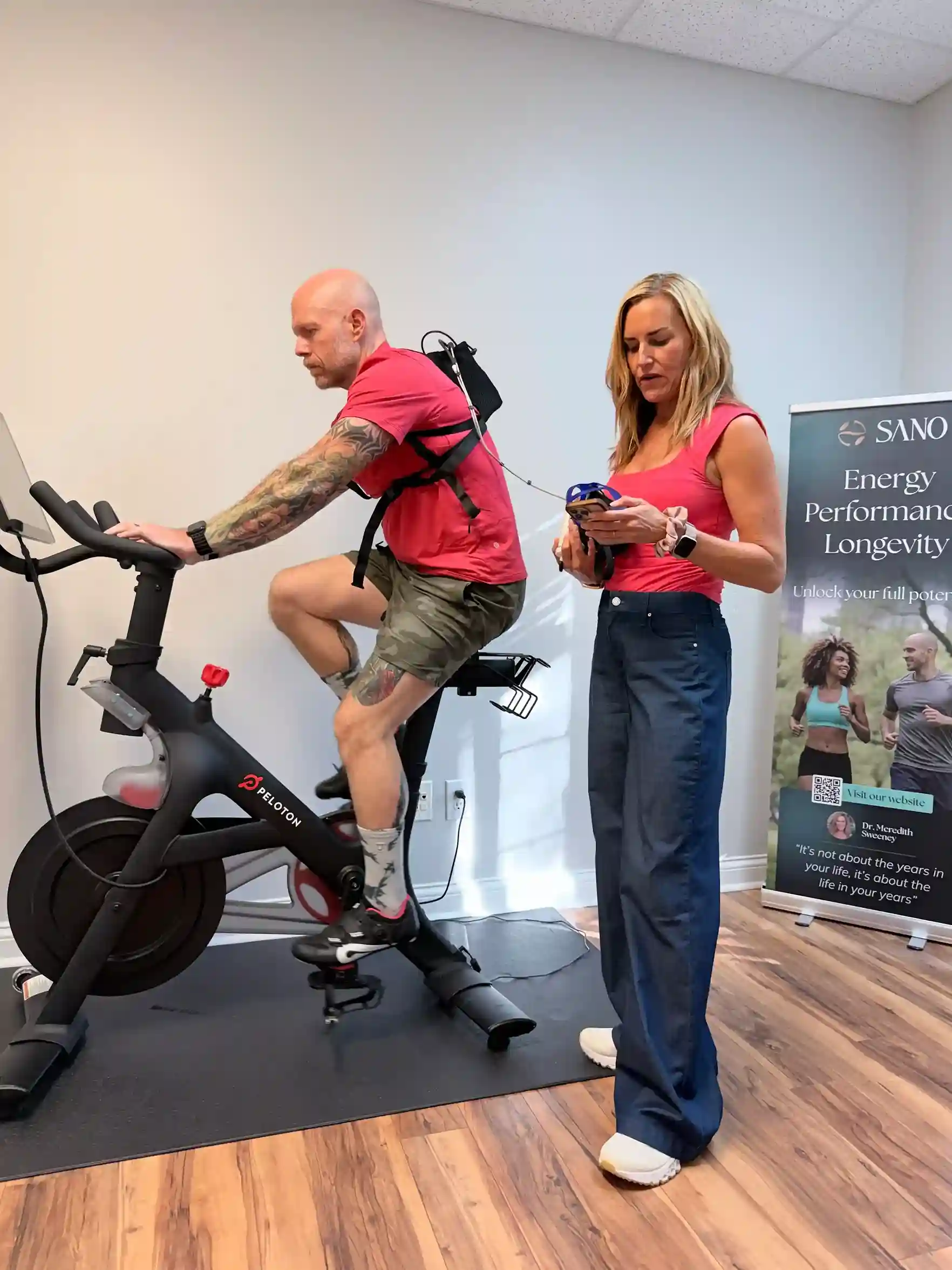
You arrive at the clinic, change into workout clothes if needed, and our team calibrates the PNOĒ rig and fits you with the mask and heart rate monitor.
You ride the bike or run on the treadmill while the PNOĒ platform captures your oxygen consumption, carbon dioxide output, and heart rate continuously. The intensity ramps progressively until you reach your peak effort.
The platform captures your recovery curve as your heart rate and oxygen consumption return to baseline.
Dr. Sweeney or the testing team walks you through the headline numbers shortly after the test. Your full 18-page report is delivered after analysis.
Dr. Sweeney spends 60 to 90 minutes walking you through your VO2 max data alongside your body composition, resting metabolic rate, and blood panel results. She presents your individualized longevity roadmap.
“I take very complex sets of data and weave them together into an actionable and realistic plan that is going to move the needle.”
Dr. Meredith Sweeney
The six questions we hear most often about the test, the report, and what it reveals.
VO2 max is the maximum amount of oxygen your body can use during intense exercise, measured in milliliters per minute per kilogram of body weight. According to the American Heart Association, VO2 max is the strongest single predictor of all-cause mortality. A higher VO2 max means a longer life and a more functional body in that life. Sano Longevity measures VO2 max on the PNOĒ platform with an exercise ramp test under 15 minutes.
The exercise ramp test itself takes under 15 minutes on either a bike or a treadmill. Total appointment time including setup, calibration, and the post-test review is approximately 30 to 45 minutes. The test is non-invasive and does not require fasting unless it is being run alongside a blood draw on your first visit.
Sano Longevity uses the PNOĒ platform, which delivers an 18-page Biological Age & Performance Analysis. The report includes your VO2 max in ml/min/kg, biological age compared to chronological age, training zones with exact heart rate ranges and benefits, energy consumption by zone (fat percent vs carb percent burn), your fat-burning crossover point, a personalized training program with resistance, interval, and cardio splits, and a recommended retesting schedule.
Biological age is an estimate of how old your cardiovascular and metabolic systems function compared to population norms. At Sano Longevity, biological age is calculated from your VO2 max score using the PNOĒ algorithm and printed on a single-page result. Patients see their chronological age and their biological age side by side. The goal of every Sano protocol is to drive biological age below chronological age over time.
VO2 max testing is included in the Longevity Program and Weight Loss Program membership programs at Sano Longevity. Standalone à la carte VO2 max testing is available by appointment. Sano is a membership-based practice. HSA and FSA eligible. See current pricing or book a free consultation to discuss the right fit.
Most patients retest VO2 max every 6 months to track progress against their training plan. Elite tier members at Sano Longevity receive bi-annual VO2 max retesting as part of their membership. Patients on the Weight Loss Program and intensive training protocols often see meaningful changes in 90 to 180 days.
Book a free consultation to talk through whether VO2 max testing at Sano is the right fit. We will walk you through what the test measures, what you take home, and how the result becomes the spine of your longevity plan.
We respond within 24 hours. No pitch. Just data. Or call (502) 208-6476.
Or send us your details and we will reach out within 24 hours.
By submitting this form you consent to being contacted about your inquiry. Your information is kept confidential and never shared.
Reviewed by
Founder, Sano Longevity in Middletown, Louisville. Board-certified bariatric surgeon. Fellow of the American College of Surgeons (FACS) and the American Society for Metabolic and Bariatric Surgery (FASMBS). Member, American Academy of Anti-Aging Medicine (A4M). Speaker, Longevity Fest 2025. More than ten years of metabolic medicine experience at Norton Healthcare before founding Sano Longevity in March 2025.
Sano Longevity
(502) 208-6476